

AI Development Services for Business Process Automation
This stops most executives in the middle of a sentence. 69% of businesses are already using AI agents to automate complicated business processes, and some are cutting their operating costs by as much as 40%. That’s not a small step forward. That’s a change in structure.
Creating AI agents to automate business processes is not just another trend in automation. It’s a change in how businesses view work. We mean smart systems that work on their own, change in real time, and still leave room for human judgment when it matters. To put it simply, this is the next step in the digital transformation process. No dashboards. Not scripts.
AI agent development for business process automation changes the way things are done by making smart systems that can take care of complicated tasks on their own, which lowers costs and makes business operations more efficient.
Boost Efficiency with Business Process Automation Service
At Virbits, we make Business Process Automation services practical and impactful. Our team builds AI-driven systems that streamline repetitive tasks, integrate complex workflows, and provide actionable insights. From designing custom AI models to deploying intelligent automation tools, we help businesses reduce operational costs, improve accuracy, and scale efficiently all while ensuring a smooth integration with your existing processes. Whether it’s predictive analytics, NLP-based automation, or end-to-end workflow management, Virbits empowers companies to turn automation into measurable business results.
What is the process of developing AI agents for business process automation?
AI agent development is the process of making smart software systems that don’t just follow directions. They understand the situation, learn from it, and act accordingly. These systems use machine learning (ML), natural language processing (NLP), and autonomous reasoning to do business tasks with little or no help from people.
Agentic AI is different from traditional robotic process automation (RPA) because it can change its behavior. It can make sense of data that isn’t organized or clean. It responds to edge cases. It makes choices based on the situation. That’s a whole other level.
Creating AI agents for business process automation is a revolutionary way to make business operations more efficient with smart software systems. AI agents, on the other hand, use machine learning and natural language processing to make decisions that change based on how the business changes. Traditional automation tools follow rules that have already been set.
What is the difference between agentic AI and traditional automation?
Let’s be honest. Traditional RPA works, but only for a while. When inputs change, rule-based systems stop working. A different format. A special case. A variable that can’t be predicted. The workflow stops all of a sudden.
Agentic AI acts in a different way. These systems learn by looking for patterns. They change based on how people use them. They make decisions better over time. And they don’t freak out when something unexpected happens.
Research from 2024 shows that companies that use agentic AI finish tasks 30% faster and make 60% fewer mistakes than companies that use traditional automation methods. That’s not a small improvement. That’s speeding up operations.
The main parts of business process AI agents
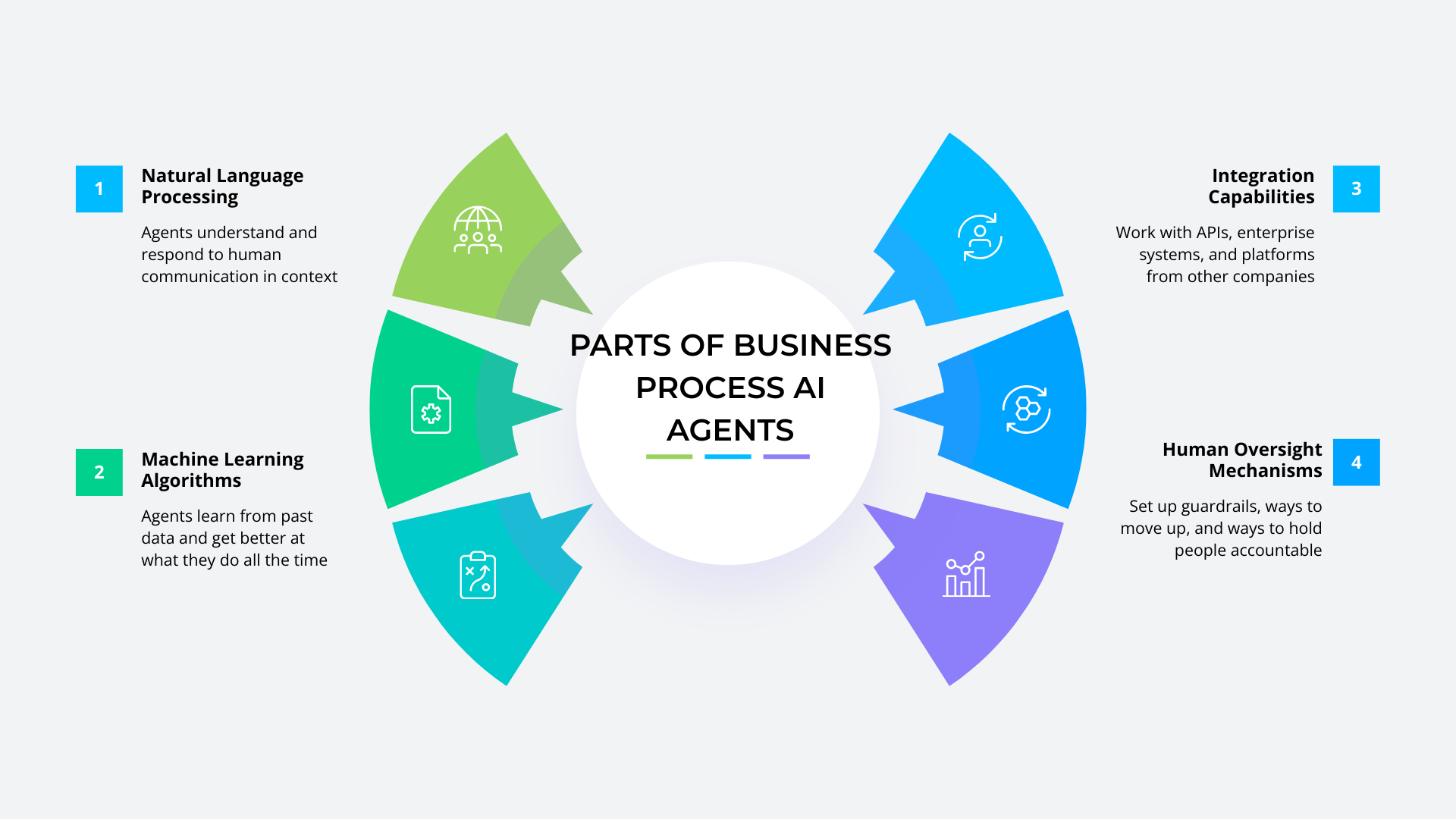
AI agents are not magical. They’re systems that are built from certain parts that work together.
- Natural Language Processing
Lets agents understand and respond to human communication in context, not just by looking at keywords.
- Machine Learning Algorithms
These let agents learn from past data and get better at what they do all the time.
- Integration Capabilities
Work with APIs, enterprise systems, and platforms from other companies.
- Human Oversight Mechanisms
Set up guardrails, ways to move up, and ways to hold people accountable.
The architecture is made up of these layers. It’s just automation with a fancier name without them.
The Change from Workflow Automation to Smart Agents
Automation in the past took care of repetition. It was expected and organized. But business isn’t organized anymore.
AI agents combine the dependability of automation with the ability to think on their feet. They handle customer questions, improve supply chains, and look into unusual financial situations, all without needing to be told to do so.
That’s the change. From scripts to systems that can think.
- Automation with AI Agents vs. Traditional Automation
- Automation in the past Automating AI Agents
- Processing based on rules Making decisions that adapt
- Only structured data Works with unstructured data
- Breaks on errors Learns from mistakes
- Set workflows Dynamic process improvement
A simple comparison and big effects.
How to Make AI Agents for Business Automation
To make AI agents, you need to figure out how they will be used, choose the right foundational models, design agentic flows, set up multi-agent orchestration, and make sure that testing and deployment pipelines are strong. It sounds easy. No, it isn’t.
To build good AI agents, the needs of the business and the technical architecture must be in sync. If you skip the planning phase, you’ll feel it later when your models start to drift or your system can’t handle more users. Being precise now stops chaos later.
How to Make an AI Agent in Steps
An infographic showing the steps in the development of an AI agent, including analyzing requirements, choosing a technology stack, and designing the agent’s architecture for automating business processes.
A visual step-by-step guide to developing an AI agent that focuses on requirements analysis, choosing the right technology stack, and designing the agent’s architecture for agentic AI development.
1. Defining Use Cases and Analyzing Requirements
Make a map of the processes that are already in place. Find the places where things get stuck. Set clear goals for success that can be measured. Sort use cases by how they will affect the business and how easy they will be to implement. This is where AI consulting with experience makes a difference. If you rush through the discovery phase, you’ll have to pay a lot to redesign later. Make a good choice. Build on purpose.
2. Choosing a Technology Stack
Most people don’t realize how important technology choices are. There are different strengths to each foundational model and platform, such as Azure Open AI Service, Google Gemini, Amazon Bedrock, and open-source alternatives. What you choose depends on how much you need to scale, how much you need to protect your data, how hard it is to integrate, and how much it will cost to own. This is how to think about infrastructure. Not trying things out.
3. Designing the Agent Architecture
Architecture decides how strong something is. Multi-agent orchestration frameworks let agents with different skills work together. Data flows need to be safe. Governance needs to be clear. Monitoring must be ongoing. Make sure your design can be audited. Design to be in charge. Make sure your design works on a large scale.
Important AI Skills and Tools
- Integrating large language models involves techniques like prompt engineering, fine-tuning, and optimization.
- Vector Database Management: Retrieval-augmented generation (RAG) for getting to contextual knowledge.
- API Development: Safe ways for systems to work together.
- Cloud Platform Expertise: Azure, AWS, and Google Cloud for deploying on a large scale.
These skills are not optional. They are the building blocks.
Comparison of Development Tools and Platforms
Modern AI development services depend on platforms that speed up deployment while still allowing for customization. Delivery times are affected by collaboration tools, development environments, and orchestration frameworks.
Final Thoughts
AI development isn’t about adding flashy features to your website or saying your product is “AI-powered.” It’s about solving real problems with systems that learn, adapt, and improve over time. When done right, AI becomes part of your operational backbone quietly increasing efficiency, reducing errors, and unlocking insights you couldn’t see before. The businesses that succeed aren’t experimenting randomly. They’re building intentionally.
FAQs
- What are AI development services?
AI development services involve designing, building, and deploying intelligent systems such as custom AI models, chatbots, predictive analytics tools, computer vision systems, and NLP applications tailored to business needs. - How long does an AI development project take?
It depends on complexity, data readiness, and scope. A basic proof of concept may take a few weeks, while full-scale enterprise AI systems can take several months including testing and optimization. - What industries benefit most from AI development?
Industries like healthcare, finance, retail, manufacturing, logistics, and SaaS benefit heavily from AI through automation, predictive insights, fraud detection, personalization, and operational efficiency. - Is custom AI development better than using ready-made tools?
Ready-made tools work for general use cases, but custom AI models provide higher accuracy and better alignment with your specific data, workflows, and business objectives. - How do businesses ensure AI systems remain accurate over time?
Through continuous monitoring, retraining models with updated data, performance testing, and implementing governance frameworks to prevent bias, drift, or compliance issues.